
Aquatic Notes Before the First Call: What a First-Time Founder Should Prepare
Most first calls about aquatic notes go badly for the same reason: the founder arrives with a mood rather than a decision. The call becomes productive as soon as four things are settled — where the product will be sold, what format carries it, how long the scent should last, and which materials you are willing to allow. Prepare those four answers, plus a cost ceiling, and a development team can tell you in one conversation whether the brief is realistic.
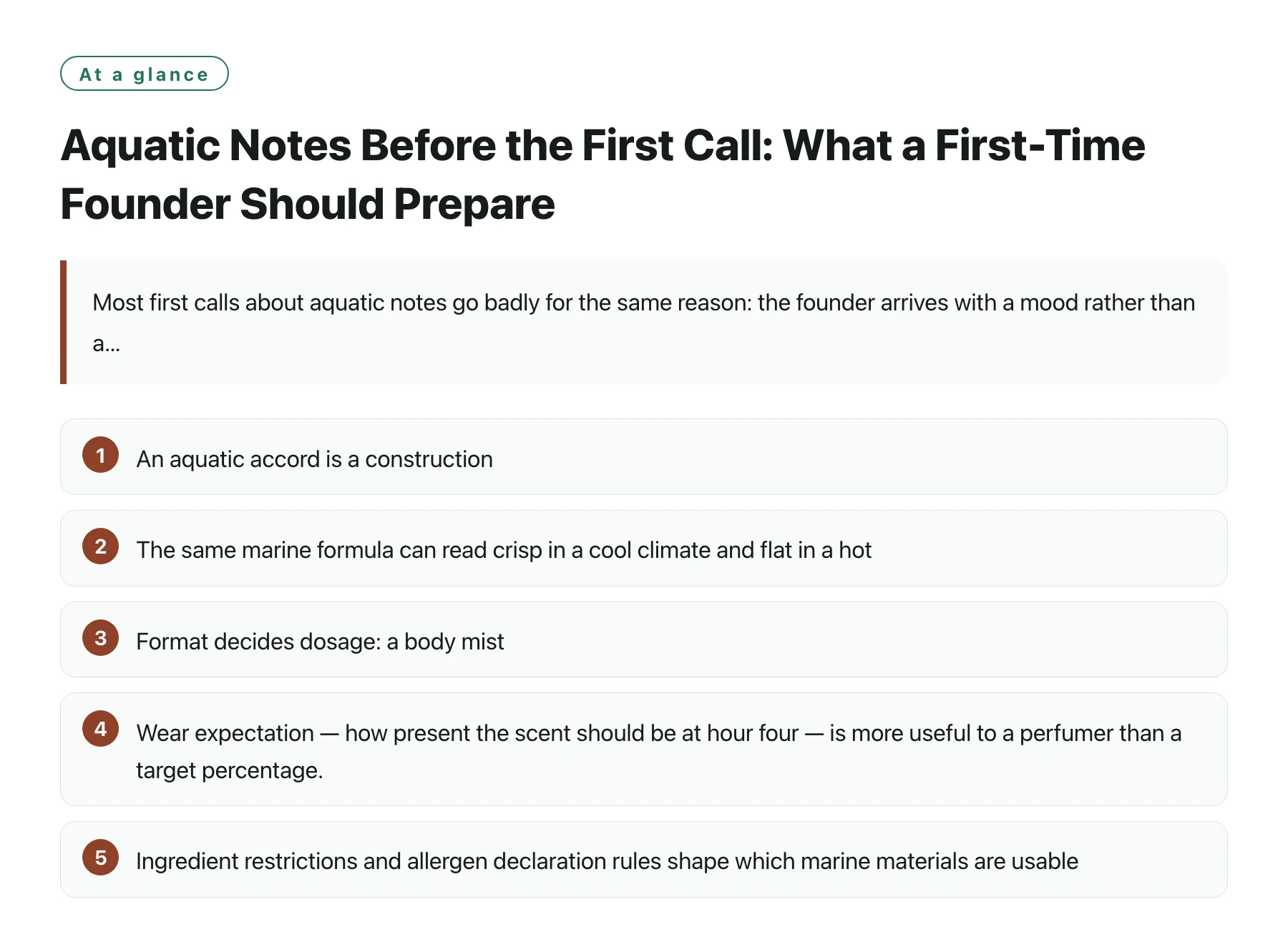
Key takeawaysAn aquatic accord is a construction, not a single ingredient, so the brief should describe the effect rather than name one note. · The same marine formula can read crisp in a cool climate and flat in a hot, humid market, so the selling market belongs in the brief. · Format decides dosage: a body mist, a roll-on and an eau de parfum carrying the same aquatic accord will be experienced differently. · Wear expectation — how present the scent should be at hour four — is more useful to a perfumer than a target percentage. · Ingredient restrictions and allergen declaration rules shape which marine materials are usable, so those limits are better raised before sampling than after.
Aquatic notes are one of the easiest things to ask for and one of the hardest to brief well. The words "fresh", "clean" and "by the sea" mean something slightly different to every person in the room, and a perfumer who guesses wrong burns a sampling round that you still pay for.
The good news is that the preparation does not require technical knowledge. It requires five written answers and an awareness of the decisions that are genuinely the brand's to make rather than the perfumer's.
What follows is written for a first-time founder who has never commissioned a scent and wants the first call to be a working session rather than a vocabulary lesson.
What an aquatic brief is really asking for
Aquatic and marine accords are usually described as a modern fragrance family, sitting alongside the older citrus, floral, chypre and woody groupings [1]. The useful part of that classification is the word accord: an aquatic effect is a blend, built from several materials that together suggest sea air, wet stone or salt on skin.
That distinction matters commercially. If you name a single note, the perfumer has to imagine the rest of the construction. If you describe the effect — bright opening, mineral middle, soft dry-down, nothing sweet — you have given a target that can be tested and approved. Specialist houses and full-service manufacturers, Xuelei among them, will each interpret the same words differently, which is why the effect has to be written down rather than spoken once on a call.
Why marine accords are built rather than found
Few natural materials smell like the sea on their own. The characteristic marine quality in modern perfumery usually comes from synthetic molecules that a perfumer selects and doses, which is why the same brief can produce a convincing ocean scent from one team and a flat, soapy one from another [2].
For a first-time founder this has a practical consequence: you are not choosing between ingredients, you are choosing between constructions. Ask to smell two or three directions rather than one attempt at a single idea.
What the market changes
A marine formula tends to open faster and read lighter in heat and humidity, and to feel sharper and more persistent in cool, dry air. If the same product ships to two very different climates, either accept that behaviour or plan two dosage levels. Deciding this before sampling is much cheaper than deciding it after the first shipment.
The four decisions to settle before the call
These are the decisions that belong to the brand, not to the perfumer. Arriving without them is the single most common reason a first call produces a vague outcome and a slow sampling round.
Where it will be sold
Name the primary market and the season you expect to launch in. Market drives both regulatory work and the sensory expectation: an aquatic aimed at a northern European buyer and one aimed at a Gulf buyer are usually not the same product, even when the brief uses identical words.
What format carries it
A spray, a roll-on, a solid and a body mist deliver very different amounts of fragrance per use. Choose the format first, because it sets the dosage range the development team has to work within. A brief that specifies an aquatic accord without a format leaves the most visible variable open.
How long it should last
Describe the wear curve in plain language: how noticeable at thirty minutes, how noticeable at four hours, how close to the skin at the end. That gives the perfumer a target that can be tested on skin, which a percentage on its own never can.
Which materials you will allow
Decide in advance whether you want a vegan, allergen-conscious, naturally derived or otherwise restricted palette. Each choice removes some tools from the perfumer's bench and may change the cost and the wear profile. Raising it on the first call is normal; raising it after a sample is approved usually means starting again.
Bring two reference products to the call, and be specific about what you want from each. "Like this one, but less sweet and less persistent" is a workable instruction. "Something fresh like the sea" is not. If you cannot name references, describe a place and a moment — a cold morning harbour, wet stone after rain, clean laundry dried outside — and say which parts you want and which you do not. Perfumers are trained to translate that, but only if you tell them what to keep and what to drop.
How to prepare for the call itself
Write a one-page brief and send it a day before the call. Include the product, the format, the fill volume, the target market, the wear expectation, the material limits, the cost ceiling and the deadline. One page forces the decisions into the open and gives the development team something to push back on.
Then prepare three questions of your own. First, how many sampling rounds are included and what happens after them. Second, who owns the formula and what exclusivity you are buying. Third, what the project would cost if it stops after the second round. A supplier that answers all three without hedging is a supplier worth a second conversation.
Expect the first samples to be directions rather than answers. A competent team will test the brief's assumptions, sometimes with a version you did not ask for, because the written words and the actual smell rarely line up on the first pass. Budget two to three rounds for an aquatic brief and you will not be surprised.
It also helps to know how a sample is expected to behave before you judge it. Fresh accords are often the most volatile part of a formula, and the top of an aquatic can fade noticeably in the weeks after it is blended. Understanding what changes a perfume sample over time before your first assessment saves a great deal of unnecessary disagreement about whether a sample "changed".
Finally, ask how the development stage connects to production. If the people who build the scent also run the filling line, the approved sample is easier to reproduce at volume. That is the practical argument for bespoke fragrance development and production bought from one supplier rather than assembled across several, and it is worth understanding before you split the work.
What not to do on the first call
Do not ask for a finished formula at the enquiry stage, do not ask the perfumer to copy a competitor's product note for note, and do not commit to a launch date before you have seen the first sample. All three create pressure that leads to shortcuts, and the shortcuts usually surface in the bulk order rather than in the sample.
Sources
- Wikipedia: Perfume —— An encyclopaedic overview of perfume covering definitions, history, the note structure of a fragrance and concentration terminology (background reference only).
- The Good Scents Company —— A reference database of aroma materials with odour descriptions, CAS numbers and typical usage information.
Frequently asked questions
What are aquatic notes in perfume?
Aquatic notes are a family of accords that suggest water, sea air, wet stone or salt on skin. They are usually blends rather than single ingredients, built from a mix of synthetic marine materials and supporting fresh, mineral or woody notes.
Is sea salt the same as aquatic?
Not exactly. Aquatic describes the watery, marine impression; sea salt usually adds a drier, slightly mineral or saline character. Many modern launches combine both, and the balance between them is a brief decision rather than a technical one.
How many samples should I expect for an aquatic brief?
Plan for two or three rounds. The first round normally tests directions rather than delivering the final scent, because the written brief and the actual smell rarely align on the first pass. Ask how many rounds are included before you start.
What should I prepare before the first call with a fragrance house?
A one-page brief covering the product, format, fill volume, target market, wear expectation, material limits, cost ceiling and deadline, plus two reference products with notes on what to keep and what to change.
Can an aquatic scent work in a hot, humid market?
It can, but it often needs a different dosage or a heavier base to hold its shape. Fresh accords lift quickly in heat, so a formula developed for a temperate market may read as fleeting in a tropical one. Tell the development team where the product will be sold.